Artificial intelligence is no longer a distant concept reserved for science fiction films or tech conferences. It’s actively reshaping one of the most critical sectors in human life: healthcare. From diagnosing rare diseases to predicting patient deterioration before doctors even notice warning signs, AI is quietly becoming one of medicine’s most powerful allies. But what does the future actually look like? And what should patients, clinicians, and healthcare systems expect in the years ahead?
This article digs into the most significant developments, honest challenges, and realistic possibilities that AI brings to modern medicine — moving beyond the hype to explore what’s genuinely on the horizon.
Where AI in Healthcare Stands Today
Before exploring what’s next, it helps to understand how far things have already come. AI in healthcare isn’t purely experimental anymore. Algorithms approved by the FDA are already being used in radiology departments, emergency rooms, and pathology labs across the United States.
Some notable examples include:
- Google’s DeepMind developed an AI system capable of detecting over 50 eye diseases with accuracy comparable to expert ophthalmologists.
- IBM Watson Health (though facing its own commercial challenges) paved the way for machine learning applications in oncology treatment recommendations.
- Aidoc and similar startups are now embedded in hospital imaging workflows, flagging critical findings like pulmonary embolisms and brain bleeds in real time.
- AI-driven sepsis prediction tools are being deployed in ICUs to identify at-risk patients hours before clinical deterioration becomes obvious.
According to a report by Accenture, AI applications in healthcare could potentially create $150 billion in annual savings for the US healthcare economy by 2026. Meanwhile, the global AI in healthcare market is expected to grow from around $11 billion in 2021 to over $187 billion by 2030, reflecting just how aggressively investment is flowing into this space.
The Most Transformative Applications on the Horizon
AI-Powered Diagnostics and Imaging
Medical imaging is arguably where AI has made its most dramatic impact, and the future promises even greater precision. Current models can already detect certain cancers in radiology scans with accuracy that rivals — and sometimes surpasses — experienced radiologists. The next wave involves multimodal AI systems that combine imaging data with patient history, genomics, and lab results to generate far more nuanced diagnoses.
For example, researchers at Stanford and MIT are developing models that don’t just flag a suspicious lesion on a lung scan — they cross-reference it with smoking history, genetic markers, and prior imaging to estimate malignancy probability with striking specificity. This moves the diagnostic process from reactive to genuinely predictive.
Drug Discovery and Development
Developing a new drug traditionally takes over a decade and costs upwards of $2.6 billion on average. AI is beginning to compress that timeline dramatically. Machine learning algorithms can now analyze molecular structures at scale, predicting which compounds are likely to bind effectively to disease targets — a task that previously required years of lab-based trial and error.
Insilico Medicine used AI to identify a novel drug candidate for idiopathic pulmonary fibrosis and move it to Phase II clinical trials in under 18 months — a process that would typically take five or more years. As these technologies mature, AI-assisted drug discovery could meaningfully accelerate treatments for diseases that currently have no effective therapies, including various forms of cancer, Alzheimer’s disease, and antibiotic-resistant infections.
Personalized and Precision Medicine
One of the most exciting frontiers is the shift from population-based medicine to truly individualized treatment. AI enables clinicians to process enormous volumes of genomic, proteomic, and clinical data to tailor treatments to specific patients rather than relying on generalized protocols.
In oncology, this is already happening. AI models are being used to match cancer patients with targeted therapies based on the unique molecular profile of their tumors — dramatically improving outcomes compared to standard-of-care approaches. The future vision extends this across cardiology, psychiatry, and chronic disease management, where treatment decisions could eventually be guided by a patient’s complete biological and behavioral profile.
Predictive Analytics and Preventive Care
Healthcare systems spend an enormous proportion of their budgets treating conditions that, in many cases, were preventable. AI is uniquely positioned to help shift the paradigm from reactive treatment to proactive prevention.
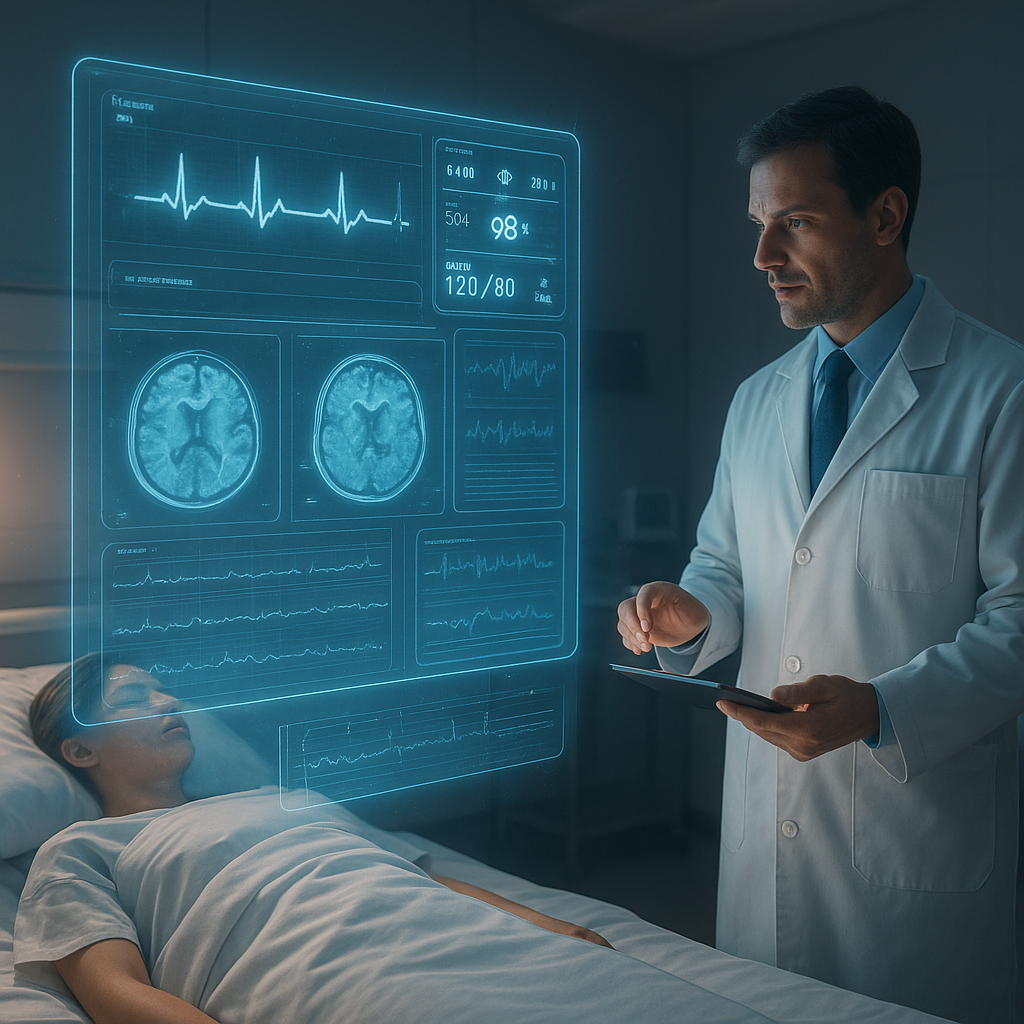
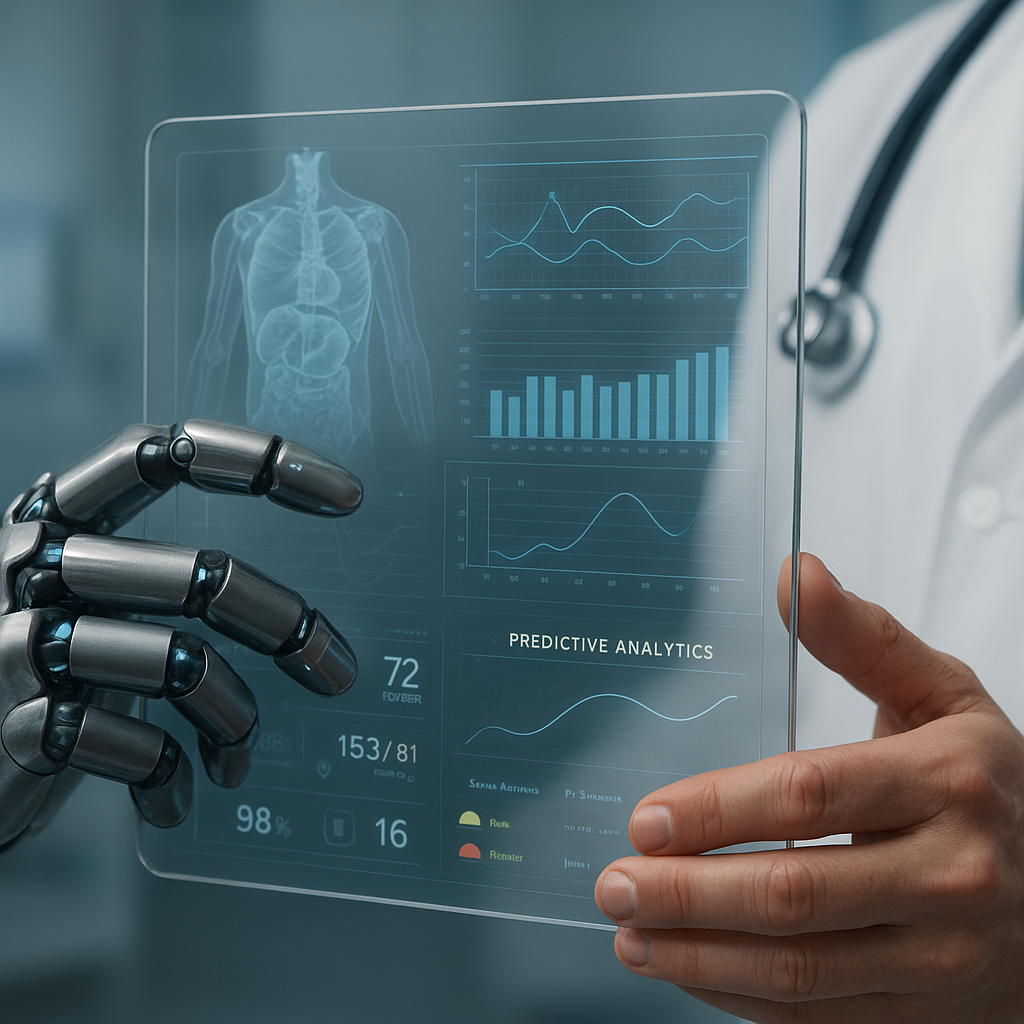
Predictive algorithms can analyze electronic health record (EHR) data to identify patients at high risk for diabetes, heart disease, or hospital readmission — sometimes years before symptoms appear. Wearable devices increasingly feed continuous biometric data into AI systems that monitor trends and flag anomalies in real time. This kind of ambient, continuous health monitoring represents a profound shift in how medicine is practiced.
What Is the Future of Healthcare With AI?
The future of healthcare with AI is less about replacing doctors and more about amplifying what healthcare professionals can do. Think of AI as a highly capable tool that processes information at a scale and speed no human can match — freeing clinicians to focus on the empathetic, complex, and judgment-intensive aspects of care that machines genuinely cannot replicate.
We’re moving toward a healthcare model that is more predictive, more personalized, and more efficiently managed. AI will increasingly power clinical decision support systems, administrative workflows, patient triage, remote monitoring, and even mental health support through validated digital therapeutics. The trajectory isn’t toward automation replacing medicine — it’s toward a deeply integrated collaboration between human expertise and machine intelligence.
What Healthcare Jobs Will Be Replaced by AI?
This is one of the most frequently asked questions, and the honest answer is nuanced. AI is unlikely to “replace” entire professions — but it will significantly alter the tasks that make up those professions.
Roles with highly repetitive, data-intensive tasks face the most disruption. These include:
- Medical coders and billing specialists — AI can already automate large portions of clinical documentation and billing.
- Radiologists and pathologists — not eliminated, but likely to shift toward oversight and complex case interpretation rather than routine image review.
- Some administrative roles — scheduling, prior authorizations, and basic patient communication are already being automated.
However, the demand for roles involving human judgment, emotional intelligence, and physical care — nurses, surgeons, therapists, primary care physicians — is expected to remain strong, even as AI reshapes how those jobs are performed.
What Type of Doctor Will Not Be Replaced by AI?
Physicians whose work depends heavily on human connection, complex ethical judgment, and physical examination are the least vulnerable to displacement. Psychiatrists, surgeons, primary care doctors, and emergency medicine physicians work in environments where interpersonal trust, real-time adaptability, and nuanced decision-making under uncertainty are central to effective care.
A patient in emotional crisis needs a psychiatrist who can listen, empathize, and navigate complex social contexts — not an algorithm. A surgeon operating in an unexpected anatomical situation needs the kind of tactile skill and intraoperative judgment that current robotic systems can assist with but cannot replace. The human elements of medicine — compassion, intuition honed through experience, and moral reasoning — remain deeply resistant to automation.
Real Challenges That Can’t Be Ignored
Optimism about AI in healthcare needs to be balanced with clear-eyed recognition of the obstacles involved. Several significant challenges must be addressed before the technology’s full potential can be realized.
Bias in AI Models
AI systems are only as good as the data they’re trained on. Many existing healthcare datasets are not representative of diverse populations — skewing heavily toward white, male, and affluent demographic groups. This creates real risk: algorithms trained on biased data can underperform for women, racial minorities, and lower-income patients, potentially worsening health disparities rather than reducing them.
Data Privacy and Security
Healthcare data is among the most sensitive personal information that exists. As AI systems require large volumes of patient data to function effectively, the question of how that data is stored, shared, and secured is critical. Regulatory frameworks like HIPAA in the US provide a foundation, but they were designed before the era of large-scale machine learning, and meaningful updates are needed.
Clinical Adoption and Trust
Even the most technically impressive AI tool is useless if clinicians don’t trust or adopt it. Building that trust requires transparency in how algorithms make decisions — a challenge given that many advanced AI models operate as “black boxes.” There’s growing emphasis on explainable AI (XAI) in healthcare, which prioritizes making model reasoning interpretable to human clinicians.
Regulatory and Ethical Frameworks
Regulators are working to keep pace with rapidly evolving technology, but gaps remain. Questions about liability when an AI-assisted diagnosis is wrong, the ethics of algorithmic decision-making in resource allocation, and appropriate standards for clinical validation all require careful, ongoing attention from policymakers, clinicians, and technologists alike.
The Road Ahead: Key Trends to Watch
Several developments are worth following closely as AI continues to evolve within healthcare:
- Foundation models in medicine — Large language models (LLMs) like GPT-4 are being adapted for clinical use, showing early promise in summarizing patient records, supporting clinical decision-making, and even passing medical licensing exams.
- AI in mental health — Digital therapeutics powered by AI are being studied and deployed for conditions like depression, anxiety, and PTSD, potentially expanding access to mental health support at scale.
- Federated learning — A privacy-preserving approach that allows AI models to be trained across distributed hospital networks without centralizing sensitive patient data, addressing one of the key barriers to large-scale AI development in healthcare.
- AI-powered surgical robotics — Systems like da Vinci are already widely used, and next-generation platforms will incorporate AI guidance to improve precision and reduce complication rates.
- Global health applications — AI tools that work in low-resource settings could have enormous public health impact in developing regions, where specialist access is severely limited.
Conclusion
Artificial intelligence in healthcare is not a future possibility — it’s a present reality accelerating at a pace that’s hard to fully grasp. The technology is already transforming diagnostics, drug discovery, preventive care, and clinical workflows in meaningful, measurable ways. Looking ahead, the integration of AI into medicine promises a healthcare system that is more personalized, more proactive, and more equitably accessible.
But that future isn’t guaranteed. It depends on addressing the real challenges around data bias, privacy, regulatory oversight, and clinical trust. It requires deliberate effort to ensure that AI serves all patients — not just those who already benefit from the best care. And it demands that the human dimensions of medicine remain central, even as machines take on more analytical heavy lifting.
The most likely outcome isn’t a world where AI replaces doctors — it’s one where the best doctors are those who know how to work effectively alongside intelligent systems. For patients, clinicians, and healthcare systems willing to navigate that transition thoughtfully, the potential is genuinely remarkable.